
Why Black Carbon?
What is Black Carbon?
Black carbon (BC) is a small, short-lived airborne particle produced by the incomplete combustion of fossil fuels, biofuels, and biomass. It is both an air pollutant and a climate pollutant. As a component of fine particulate matter (PM₂.₅), black carbon is linked to adverse human health effects and near-term climate warming. When deposited on snow and ice, particularly in the Arctic, it darkens the surface and accelerates melting.
The Challenge: Difficult to See, Difficult to Measure
Black carbon is largely invisible in the environments where we encounter it, and exposure can vary significantly over short distances. Health Canada identifies areas near major roads and highways as locations of elevated exposure to traffic-related air pollution, a complex mixture that includes black carbon.
Canada has sophisticated air-quality monitoring systems, but regional monitoring cannot represent every localised condition encountered while walking beside a busy road, cycling through traffic, or moving through a neighbourhood. Environment and Climate Change Canada similarly notes that national and provincial black carbon inventories do not distinguish localised emission sources.
Measuring black carbon also presents a technical challenge. Conventional particulate sensors can measure PM₂.₅, but measuring the total concentration of fine particles is not the same as selectively measuring black carbon within that mixture. High-quality black carbon instrumentation exists, but cost and complexity can limit its use in dense networks of portable sensors.
The Clean Air Living Map (CALM) asks: Can we develop a low-cost, portable way of detecting black carbon that allows communities to investigate their own air?
How Do We Detect It?
Laser-Induced Graphene
Researchers in York University’s Electronics Additive Manufacturing (E-AM) Lab, led by Professor Gerd Grau, are investigating a new approach to black carbon detection using laser-induced graphene (LIG). LIG is an electrically conductive carbon material that can be produced by using a laser to transform the surface of carbon-containing materials such as polyimide. For CALM, the research hypothesis is that black carbon particles will make contact with the LIG structure and produce a measurable change in its electrical properties.
The team is fabricating LIG on polyimide using a scanned CO₂ laser and characterizing its response to controlled quantities of black carbon. The research investigates electrical measurement methods including resistive, capacitive, and multi-frequency approaches, while examining interference from factors such as humidity, pollen, and other particulate matter.
From Sensor to CALM
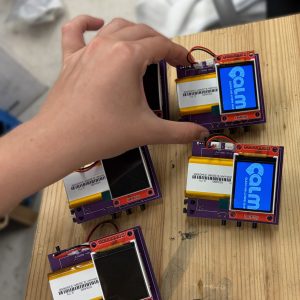
The Clean Air Living Map (CALM) device is being developed to take this emerging sensing technology out of the laboratory and into communities. The CALM device combines the LIG sensor with a low-cost ESP32 microcontroller, rechargeable battery, display, and mobile connectivity. A companion application can time-stamp measurements, associate them with geographic location, and transmit them to the CALM web platform.
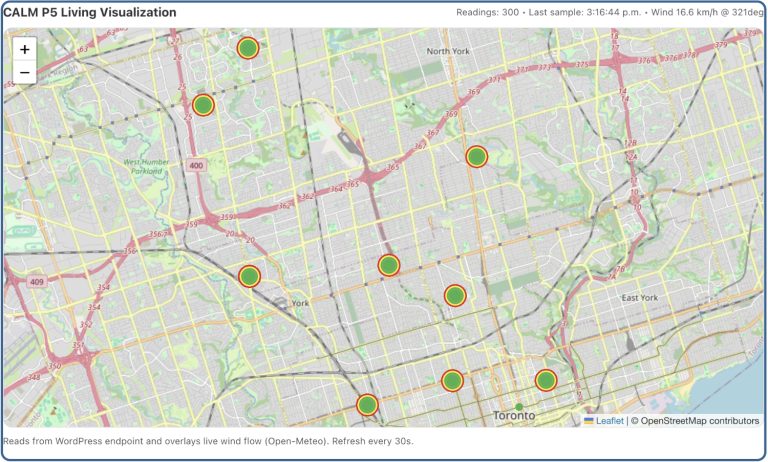
Measurements from multiple devices can then be visualised spatially and over time. Instead of asking only “What is Toronto’s air quality today?”, CALM allows us to investigate more localised questions: What is happening on this street? Near this highway? On my commute? How does exposure change as I move through the city?
CALM augments established scientific air-quality monitoring networks by exploring how portable sensing and citizen science can complement them by investigating pollution at the scale of everyday lived experience.
Making the Invisible Visible
Measurement is only part of CALM. The project brings together engineering, environmental research, citizen science, computational art, and design to explore how environmental data can become meaningful within everyday experience.
Artists and designers are being commissioned to develop works incorporating the CALM sensing platform, including wearable objects, installations, sculptures, performances, interfaces, and interventions in public space. The goal is not simply to display data, but to explore how art can make an invisible environmental condition perceptible.

Crowdsourcing the Air We Breathe
CALM extends this process through citizen science. Artists and designers will work with citizen scientists who take CALM devices into their communities, collecting geolocated measurements as they move through neighbourhoods and everyday environments.
Instead of relying on a single sensor, CALM explores the potential of many people making many measurements in many places. These observations can be brought together through the Clean Air Living Map to create a community-generated picture of localised air pollution. Artistic works become part of this process as sensing instruments, public interventions, and ways of communicating what participants discover.

Why This Matters...
Air pollution is not distributed evenly. Where we live, work, and travel—and our proximity to highways and other pollution sources—can affect exposure. Health Canada estimates that approximately 10 million people in Canada live within 500 metres of a highway or 100 metres of a major urban road, making localised exposure an important public-health and environmental-justice issue.
Who is exposed? Where does that exposure occur? Who has access to information about it? And what happens when communities participate in producing that knowledge themselves?
CALM brings together sensing technology, open data, art, and citizen participation to investigate these questions and better understand the air we share.

Resources
Current Air Quality
Environment and Climate Change Canada — Toronto Air Quality Health Index
Current and forecast AQHI conditions for Toronto.
Air Quality Ontario — Toronto Downtown AQHI
Current Air Quality Health Index information and monitoring data from Ontario’s air-quality network.
City of Toronto — Air Quality
Information about air pollution, health, the AQHI, and Toronto’s response to poor air quality and wildfire smoke.
Black Carbon and Air Pollution
Environment and Climate Change Canada — Canada’s Black Carbon Inventory
Canada’s national inventory of black carbon emissions.
Environment and Climate Change Canada — Canada’s Black Carbon Inventory Report 2026
Current federal data on black carbon sources, emissions, trends, and reporting.
Health Canada — Traffic-Related Air Pollution
Research and guidance on traffic-related air pollution, including black carbon, and health impacts in Canada.
Health Canada — Health Impacts of Traffic-Related Air Pollution in Canada
Health Canada’s scientific assessment of the health burden associated with traffic-related air pollution.
Our Research
Electronics Additive Manufacturing (E-AM) Lab — York University
Research laboratory developing additive-manufacturing approaches to electronics, including flexible electronics and sensors.
n-D::Studio Lab
Research-creation lab exploring ArtScience, Computational Art, and Interactive Architecture.
DesignWith
Participatory design lab and community space supporting collaborative approaches to sustainability, circular design, and environmental action.